Saturday, 10 September 2011

The Help

The HelpThe Help by Kathryn Stockett

My rating: 5 of 5 stars


Not only one of the best books I've read this year, The Help is one of the best books I have ever read.

I was completely enthralled by the exquisitely detailed world of 1960s Jackson Mississippi that the author wove from details of battenburg lace, extra-strength hairspray and pastel ladies suits. I wanted to be Skeeter and Minnie's best friend... yes, both of them. My heart ached when they struggled, and leapt with joy when they triumphed, because I felt an honest emotional connection with these people and their world. It is rare for me to be as caught up in a book as I was with this book, but I can't deny it; I'm in love with The Help!

The Help follows the story of societal black sheep Skeeter, who went to college to learn rather than to earn her Mrs. degree like her friends. She returns to her home town of Jackson Mississippi and finds that she no longer fits into the mold that was cut out for her, to be a demure southern belle who accepts the status quo. Instead, she is uncomfortable with the social strata, with the expectations that are laid out for white ladies of her age, and with the way her friends treat their children, husbands, one another, and most significantly, the household help.

Setting out on a combined quest to tell the story of black household workers and to find the maid that raised her with such compassion, Skeeter finds herself caught up in the changing world of Civil Rights, with a richly painted historical backdrop of events including the Medger Evers assassination, the walk on the moon, Kennedy's presidency and assassination, Rosa Parks, lunch counter sit-ins, and the speeches and work of Martin Luther King Jr. She befriends Abileen, her friend's maid, who begins by assisting her in her writing of a housekeeping column, and winds up becoming a true friend, during an era when such relationships are more than verboten.

This phenomenal novel explores the ways in which women relate, from mothers and daughters, to childhood friends, to our ways of dealing with those who work in service. I see echoes of the way Miss Hillie dealt with Abileen in the way I see people speak to waitstaff and hotel staff today, and it hurts my heart to think we haven't quite outgrown all of our prejudices. Test yourself as you read; have you ever used this kind of dismissive tone, or that way of ignoring someone? Even if it is less harsh than the realities of the 60s, it's worth reminding ourselves that we need to constantly reexamine what we were taught as children and whether or not it affects the way we treat people today.

Read this book. Read it immediately. Then read it again.


View all my reviews

Friday, 9 September 2011

In The Night Room

In the Night Room: A NovelIn the Night Room: A Novel by Peter Straub

My rating: 1 of 5 stars


Bizarre and fantastical tale of two writers caught up in supernatural events unfolding around them, involving ghosts, a wickedly rabid fiction fan, angels, and a spirit guide who communicated via email, mostly using 1337 5p34k. Which makes long passages of the book a headache to read if you, like me, hate that kind of thing.

I didn't enjoy this book. It was just odd, and for me to say that says a lot, being a chick who loves horror, dystopia and sci-fi, but the story line seemed contrived and self-serving, and half seemed to be a nod promoting Straub's earlier book (Lost Boy Lost Girl) which is mentioned often enough in the text that I considered starting a drinking game around it's mention.


View all my reviews

Monday, 5 September 2011

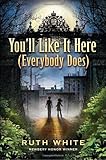
You'll Like It Here

You'll Like It Here (Everybody Does)You'll Like It Here by Ruth White

My rating: 4 of 5 stars


Interesting YA take on aliens and dystopia.

The first chapter of the book seems oddly disconnected from the rest of the book. (Spoiler alert!) The author attempts to use the unreliable narrator technique and it falls flat, because it isn't that the narrator is unreliable, it's that she's outright lying to the reader and herself, is misrepresenting things in such a way that later it seems completely unconnected to her character. It's almost as though a different author wrote the first chapter (badly) and a more talented writer who understood the characters better took over from there.

After this initial speedbump, the book is a cute, fun read about a young alien girl and her family, struggling to survive after leaving the Earth of today for another dimension, where the government has been overthrown by big business, and a public kept in perpetual stupor works endless days for the reward of being put down at age 65. Oh yes, I yelled "Soylent Green is People!" the first time I saw the vacation 65 bus, I'll admit it. Anyone who is a fan of classic sci-fi will find familiar themes here, stolen from Brave New World, Farenheit 451, 1984 and other classics, reinterpreted for kids in an approachable format with likable characters.


View all my reviews

Friday, 2 September 2011

The New Good Life: Living Better Than Ever in an Age of Less

The New Good Life: Living Better Than Ever in an Age of LessThe New Good Life: Living Better Than Ever in an Age of Less by John Robbins

My rating: 5 of 5 stars


I wish I could convince everyone I care about to read this wonderful, enlightening book.

What does living the "good life" mean to you? Is it an ever more abundant pile of "things" that fill our ever larger homes that we spend less and less time actually occupying? Is it a bigger pile of cash in your bank account or a fancier car or a boat that you barely get to use because of all the hours you have to work to pay for it?

John Robbins, born heir to the Baskin and Robbins ice cream fortune had it all as a child, right down to the ice-cream-cone shaped swimming pool, but he chose to turn his back on the fortune his family had made to pursue a different kind of good life, one centered around the relationships we make with other people, living harmoniously with the earth, and giving back to the world around us rather than relentless consumerism and pursuit of a transitory wealth that won't carry with us when we leave this earth, no matter how hard we cling to it.

This book examines the trade-offs we make in our lives, from longer work days and dreary commutes to angry, violent children raised by a culture of television and convenience to an earth dying under the burden of too many people using industry to recklessly create too much garbage. How can we find real happiness, real contentment, among the rabble of today's more-more-more treadmill? When statistics show that once you rise above the poverty level, money does not increase your happiness (the richest tiny percent of Americans are no happier it seems that the simple-living Amish) how do you catch that elusive wish for a good life? Is it by having a family game night? Using green cleaners in your home? Offsetting your carbon footprint by trying to walk instead of ride, eat vegetables instead of meat?

For everyone there is a balance to achieve, and this book is about finding that balance in your own life. Peppered with anecdotes from his childhood and simple adult life as well as recipes for simple foods and green cleaning products, it's funny and useful and heartfelt. I appreciated the thought that went into this book, and the easy conversational style that makes it read like a chat with a good friend.


View all my reviews

Thursday, 1 September 2011

Await Your Reply

Await Your ReplyAwait Your Reply by Dan Chaon

My rating: 3 of 5 stars


I really wanted to love this book. The author is critcally acclaimed and this novel in particular is said to speak for our current age. The theme of identity and truth is one I've been exploring a lot in fiction this year, and I was looking forward to this one very much.


The truth was, though, that the beginning, which starts in three unconnected narratives, bored me. I kept putting down the book and picking up something else instead (I usually have four to six books going at any one time, and I have started *and* finished at least that many since I started this book). It didn't grip me. But I kept on plugging away because I was supposed to like it. And it would get better, right?


Well, in some places in this book the insight and style are breathtaking. In other places, there are long passages that seem disconnected and trite. In some places, I ached for the characters, and in others I rolled my eyes, because it seemed like the author was trying too hard. Overall, it took me a while to manage my way through, and while I was somewhat disappointed, it wasn't awful. I think in some ways I just set my expectations too high for this book.


View all my reviews

Wednesday, 31 August 2011

The Unit

The UnitThe Unit by Ninni Holmqvist

My rating: 5 of 5 stars


Remarkably stunning portrait of life in a society where certain groups of people are considered dispensible to the world at large, and are harvested like a field for whatever they can offer.

Dorrit is a writer. She lives alone in her small house with her dog Jock. She walks on the beach, and reads, and writes, and is having a torrid love affair with a married man. Her life isn't perfect, but it's hers and makes her happy. Unfortunately, she is also turning 50, and in her society when you turn 50 as a woman (or 60 as a man) and are childless and without an important or caretaking job you become dispensible.

You are transferred to a unit where you'll have no worries for the rest of your brief life. You're provided with an apartment and plenty of amenities, such as a full gym, shopping centers where you never have to pay, movie theaters and art galleries. There's a library to find reading materials, and if you're an artist or writer, you'll recieve a studio or computer to work on your craft.

Most of the people in The Unit remind me of me. They're writers and artists and librarians, ladies who worked in a shoe store all their lives who kept their nose stuck in a book, and men who quietly worked a full career while writing in their spare time, their hearts broken too much to fall in love. They are people I would want to hang out with, and people I could love. They're people I could be.

The crisp briskness of the prose is startling in places, but rather amazing to read. The author doesn't coddle the reader, but forces them to face the harsh realities that a society which focuses on only tangilble contributions can create. I often had to stop reading, my eyes full of tears, because I was so affected by this novel. One night in bed, after reading about how Dorrit's lover Nils refused to write an affadavit stating that she was loved (because he would have to leave his wife - who he didn't love - and that would mean his child would grow up in a single parent home) I sobbed to my husband, making him assure me that he would write such an affadavit, stating that his love for me meant I should be saved. Yes, it truly got into my head.

And in a good way, I think, because it highlights the inherent value of the people that society sometimes puts in a corner. I feel this way sometimes as I'm not raising a child right now. People don't, on meeting me, know that I once had a child, and therefore I seem somehow less to them, somehow not connected. I have seen it in their eyes; that sense that I don't understand their life, couldn't understand, that I just don't have what makes life worthwhile. I feel pushed to the edge of conversations, where I politely smile and hope for the conversation to turn from babysitters and diapers to books or movies or somewhere I can contribute. I want to scream that there is more to life, sometimes, that there is more to them, and to please connect with me. Occasionally I'll bring up an experience from my brief time with my daughter Grace, but often that is more painful than staying silent.

The problem with staying silent is that you validate that trap of being seen as less, that trap which might lead you into a Unit, yourself.


View all my reviews

Monday, 29 August 2011

Bumped

Bumped (Bumped, #1)Bumped by Megan McCafferty

My rating: 3 of 5 stars


This interesting YA novel contemplates the lives of two twins in a society where almost no one who is over the age of 18 can become pregnant. When young wombs are marketable, and a baby can be traded for college tuition or plastic surgery (or cold hard cash by the parents of the womb-owner), what young woman wouldn't make the choice to "bump" and carry a baby as a paid surrogate? Melody, the adopted child of college professors has known for much of her life that she would be a paid surrogate, and her college professor parents have spent a majority of that time pushing her into pursuits that would raise her commodity - the price of her brand, or the fee she could command as a surrogate. Until one day, she recieves a message from a girl who is her identical twin sister.

Harmony has been raised in a religious compound which is a perversion of Amish and Hudderite groups. While they dress simply and work the land by hand, they also believe in marrying young girls by 13 so they can produce as many babies as possible for their community at large. The marriages are arranged by a council of church elders, and the girls step into their husband's bedrooms ill prepared - to say the least - for their new lives as wives.

There are some problems with this book, not the least of which is the lack of explanation for the disappearance of artificial insemination and in vitro fertilization. Why do the teens have to have sex together in order to procreate? They are even encouraged to take drugs to loosen up to have sex with strangers. This seems very odd to me and not like a natural progression of society at large.

I can buy the new technologies. I can accept that advertising campaigns and product placement have made it "cool" to be pregnant as a teen. I can even accept parents pushing their kids into it for money, after seeing parents push their kids into uniform to get Army recruitment bonuses, even during a bloody war in the Middle East, but I just can't believe that this new society which has so advanced the use of computers and messaging would completely abandon the science of reproduction when they've been struck with a virus that affects fertility. Maybe the YA audience the book is inteded for won't scratch their head at this one as much, but it really bothered me and dropped my rating stars because of it.


View all my reviews